
The "three months' salary" rule isn't tradition — it's advertising. De Beers invented it (starting as one month's salary in the 1930s, inflated to three by the 80s) to set a price floor on a product they controlled. You're not obligated to honor a marketing campaign. Here's a more honest way to run the numbers.
What People Actually Spend
Surveys put the average US engagement ring around $5,000–$6,000, but the median is far lower — most couples spend $1,000–$4,000, and a growing share spend under $1,000 on purpose. The averages are dragged up by a small number of very expensive rings. There is no normal; there's only what fits your life.
The Only Rule That Holds Up
Spend what doesn't set your life back. A ring shouldn't delay a house deposit, add card debt to a marriage, or eat the honeymoon. The couples happiest with the decision five years later are the ones who bought the ring inside their means — whatever those means are.
Why the Math Changed: Lab Stones

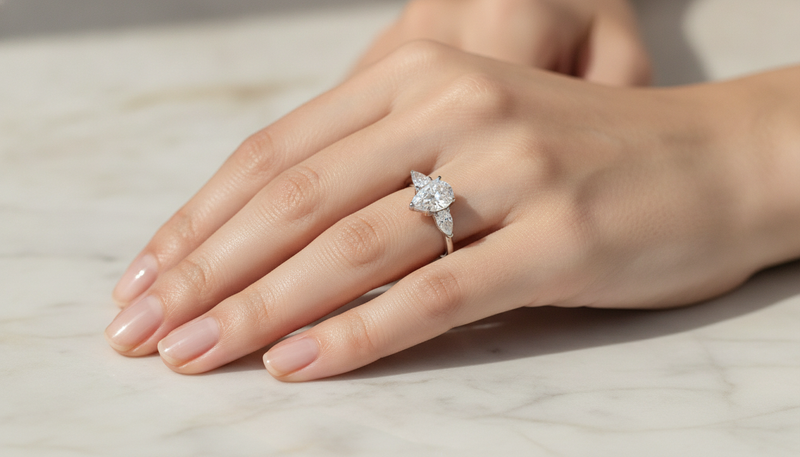
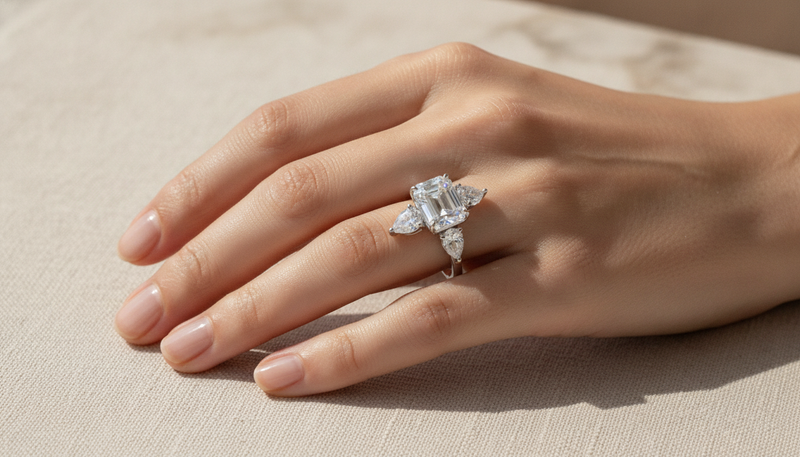
The reason the old rule is collapsing: the look no longer requires the spend. Lab-grown diamonds cut the price roughly in half. Moissanite cuts it by ~95% — a D-color, VVS1 stone with more fire than diamond, a 9.25 Mohs hardness built for daily wear, and it passes a thermal diamond tester. Our engagement rings run $149–$699, and full bridal sets — ring plus matching band — start at $249. The honest comparison is in Moissanite vs Diamond.
Where the Money Should Go Instead
Couples who skip the diamond markup redirect it: house fund, honeymoon, paying off loans, or simply a bigger stone — a 3-carat moissanite costs less than a 0.3-carat diamond. That's not settling; that's arbitrage on the only product where the premium is mostly story.
A Simple Framework

Decide the total you can spend without borrowing. Pick the silhouette she actually wants (check her saved posts — solitaire, halo, toi et moi, oval). Then choose the stone type that fits the budget to that silhouette. Size her ring right the first time with the ring size guide, and read why couples pick moissanite before you assume you need the mine stone.
Engagement Budget Questions
Is the three months' salary rule real?
No — it started as a De Beers ad campaign in the 1930s. There's no etiquette rule behind it; spend what fits your finances.
What does the average engagement ring cost?
Averages land around $5,000–$6,000, but the median is much lower — most couples spend $1,000–$4,000, and many happily spend less.
Is a moissanite engagement ring tacky?
No — it's a real lab-grown gemstone with more fire than diamond, and it's become a mainstream choice for couples who'd rather fund a house than a markup.
Can you upgrade a ring later?
Yes — many couples start with moissanite or a smaller stone and upgrade at an anniversary. The setting and the moment matter more than the year-one carat count.