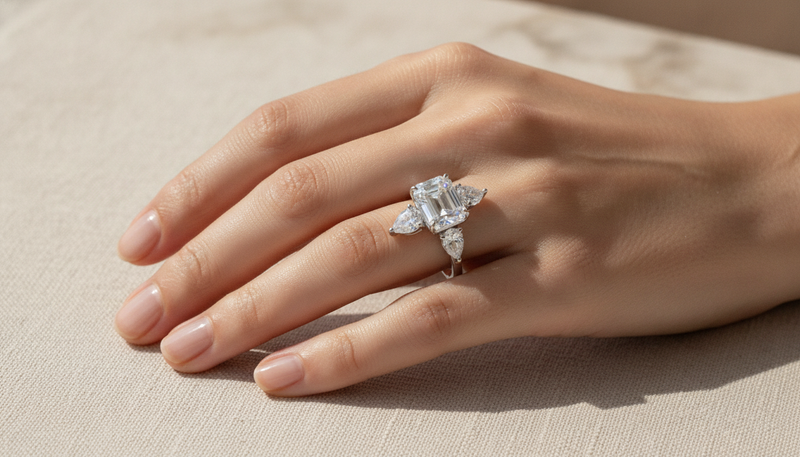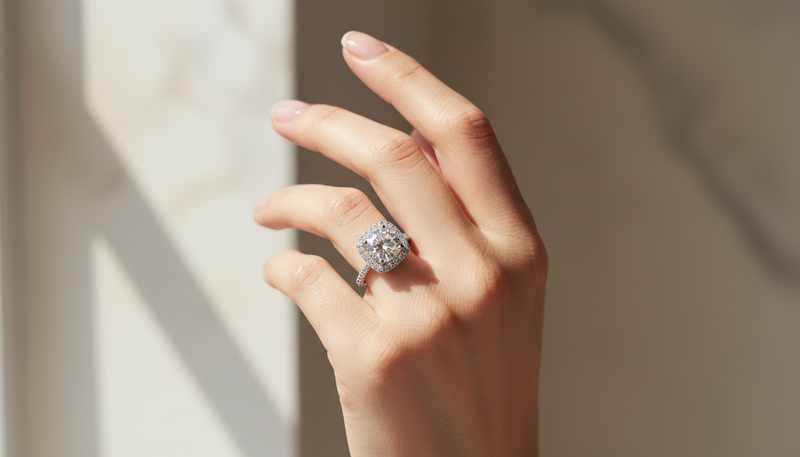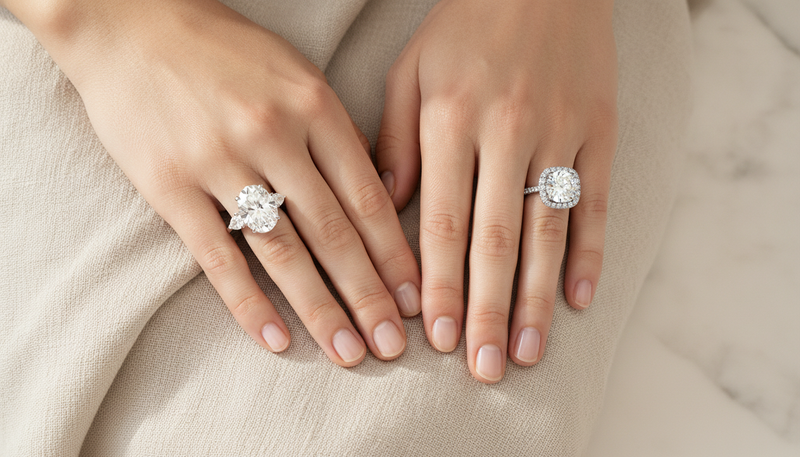

The pear — sometimes called a teardrop — is a hybrid of the round brilliant and the marquise. It's one of the most flattering shapes on the hand and one of the easiest to get wrong when buying.
Which way does the point face?
Toward the fingertip. Traditionally and almost universally, the narrow point of a pear faces away from the wearer's body, up the finger. This is what creates the elongating effect — the eye follows the taper and reads the finger as longer and slimmer.
There's no rule against wearing it the other way, but it fights the shape's main advantage.

What to check before buying
Symmetry. Draw an imaginary line down the centre — both halves should mirror each other. Asymmetry in a pear is far more visible than in a round, because the eye has a clear axis to judge against.
The point. It should be sharp and, critically, protected by the setting. A bare point is the most vulnerable spot on any faceted stone. Look for a V-prong or bezel over the tip.
Bow-tie. Like ovals, pears can show a dark band across the widest part if the cut is poorly proportioned. Well-cut stones show little to none.
Who it suits
Anyone wanting length in the finger — it works like an oval but with more personality. It also delivers noticeable face-up size for its carat weight, for the same geometric reason ovals do (explained here).
It also pairs unusually well in two-stone settings, which is why it shows up so often in Toi et Moi rings.
Our Pear Solitaire Ring starts at $199 with centre stones from 1ct to 4ct, and the 3ct Pear Bridal Set with matching band is $249. More in Wedding & Bridal. Size first with the Ring Sizing Guide.
Pear Shaped Moissanite Questions
Which way should a pear shaped ring point?
Toward the fingertip, away from the body. This is the traditional orientation and it's what creates the elongating effect on the finger.
Are pear shaped stones more fragile?
The point is the vulnerable part of any pear-cut stone. A good setting protects it with a V-prong or bezel over the tip. Moissanite's 9.25 Mohs hardness helps considerably, but the setting still matters.
Does a pear look bigger than a round?
Yes, at the same carat weight. Like ovals, pears are cut shallower and longer, putting more weight into visible face-up area rather than depth.
What should I check when buying a pear shaped stone?
Symmetry down the central axis, a sharp and well-protected point, and no visible bow-tie shadow across the widest part of the stone.