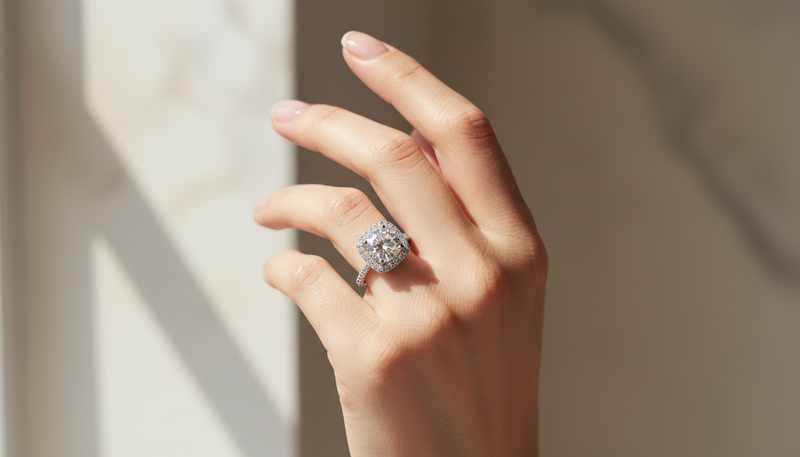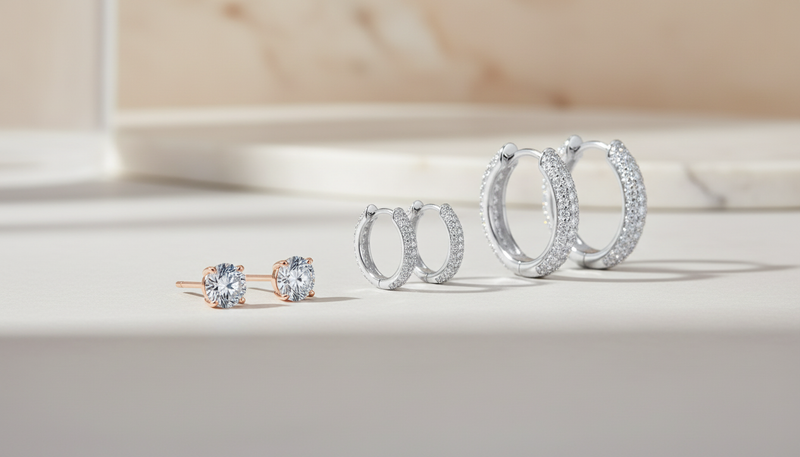

Moissanite is a real, naturally rare gemstone — silicon carbide — first discovered in 1893 inside a meteor crater in Arizona by the French scientist Henri Moissan. He thought he'd found diamonds. He hadn't. He'd found something else entirely.
Today, moissanite is grown in labs with extraordinary precision. Same crystal structure, same optical properties, grown in weeks instead of billions of years.
What makes it different from a diamond
Moissanite is its own gemstone. It is not a diamond simulant, not a fake, not a "diamond alternative" — it's a distinct mineral with its own identity.
- Hardness: 9.25 on the Mohs scale. Second only to diamond (10). Harder than sapphire, ruby, or emerald.
- Brilliance: Refractive index of 2.65 versus diamond's 2.42. That means it bends light more — which is why moissanite actually throws more fire than a diamond.
- Fire (color dispersion): 0.104 versus diamond's 0.044. More than double the rainbow flash.
- Price: Roughly 1/10 the cost of an equivalent diamond.
Is it lab-grown?
Yes. Natural moissanite is vanishingly rare — you'd need to raid a meteor to find enough for a single ring. Every moissanite on the market, including ours, is lab-grown. That means zero mining, zero environmental damage, zero ethical baggage.
Will it pass a diamond tester?
Modern moissanite passes standard thermal-conductivity diamond testers. It does not pass a dual moissanite/diamond tester, which is the tool professional jewelers use. We don't hide this. Moissanite is its own stone and we sell it as moissanite, not as a diamond.
Will it last?
A grandchild could inherit your moissanite engagement ring looking exactly the way it did on day one. It won't cloud, fade, or scratch under normal wear. Cubic zirconia (a genuine simulant) clouds in months. Moissanite lasts lifetimes.
Why people choose it
Three reasons, usually: the money, the ethics, and the sparkle.
A 1.5ct diamond engagement ring costs more than a used car. A 1.5ct moissanite from Stone Blvd costs less than dinner for four. Ethically lab-grown, certificate-backed, delivered worldwide.
Same fire. Different math.